Saving Water Starts Before Irrigation
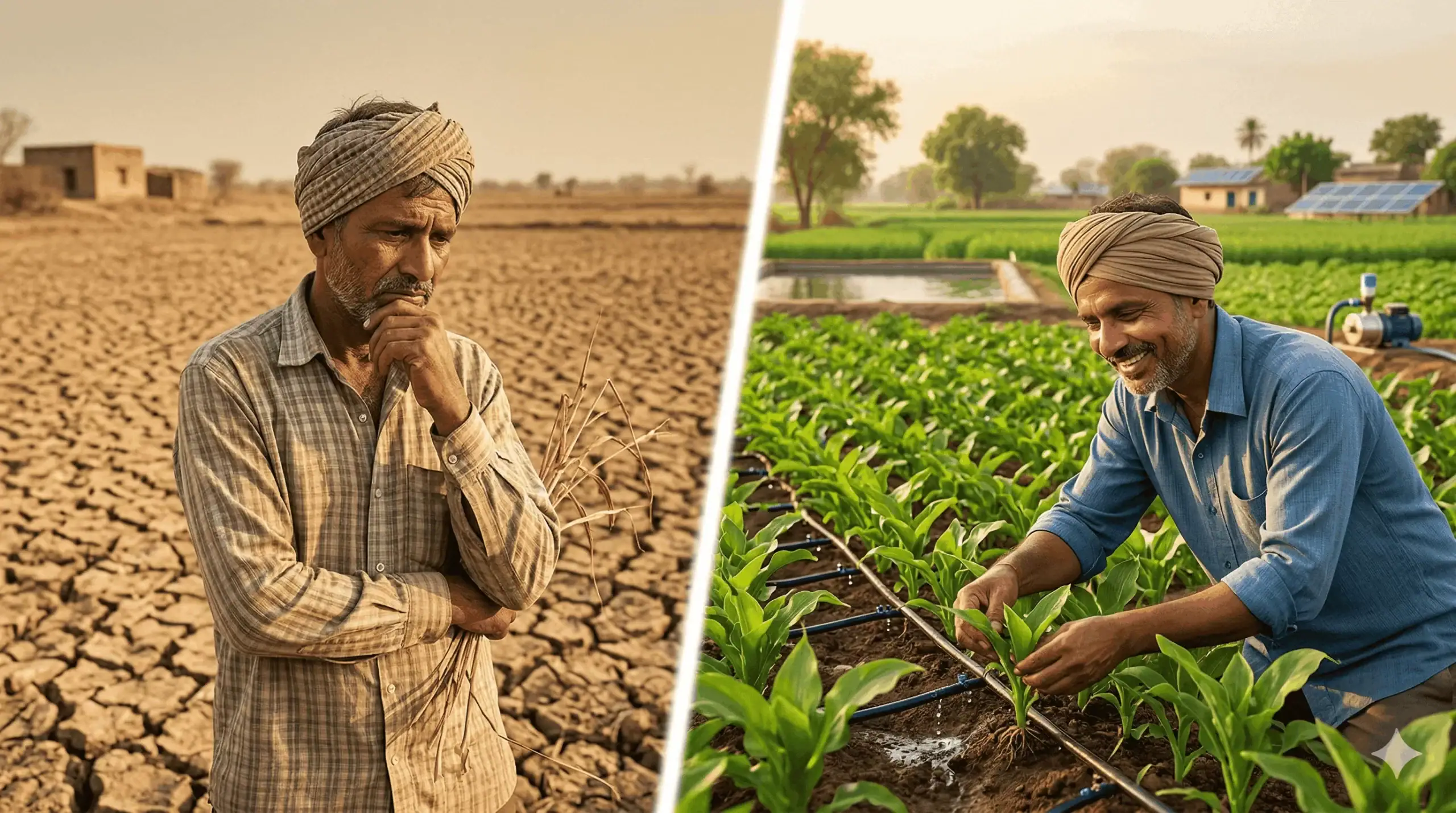
‘How Nath Bio-Genes is helping farmers reduce water use through seeds and on-ground practices’
March 22 is World Water Day. A day when the world pauses to reflect on water. Some will share infographics. Some will participate in rallies. Others will log in to talk about saving water on platforms whose data centres use 200–300 billion litres per year to stay cool. That, in many ways, sums up World Water Day.
However, none of it would make a difference in a farmer’s life, as he would still be staring at his dry field in the middle of summer, hoping that it rains on time. There is no moving on.

India is home to nearly one-fifth of the world’s population. Yet it holds just 4% of its freshwater resources. That gap, between how many mouths to feed and how little water exists to grow that food, is not a looming crisis. It is today’s problem. And it is getting worse every season.
Agriculture is where the crisis lives
Agriculture accounts for nearly 90% of India’s freshwater use. And yet flood irrigation, still widely practised, operates at less than 40% efficiency. More than half the water used never reaches the crop. Meanwhile, groundwater is depleting, rivers are getting polluted, and farmers are fighting for access to the one thing their crops cannot survive without. Nath Bio-Genes has been quietly working on this problem longer than most.
Thinking beyond the seed
Nath Bio-Genes has been in the business of seeds for decades. But its mission has always been bigger than the seed itself.
Recognising that traditional farming techniques can be wasteful, the company has invested heavily in drought-tolerant, short-duration hybrids that thrive with less water and fewer inputs. These varieties are bred to withstand dry spells and erratic weather, improving moisture retention in the soil and reducing irrigation frequency. Simply put, help farmers produce more while placing less strain on groundwater.
Changing how farmers use water
Developing the right seed is only half the job. How a farmer waters that crop matters just as much.
This is where Nath Bio-Genes goes further than most. Through its stewardship programme, the company deploys trained field representatives called Nath Farm Advisors, who work directly alongside farmers.
Farm by farm, these advisors help farmers move away from wasteful practices and toward methods that stretch every drop further. Direct Seeded Rice, or DSR, is one such method. Unlike traditional paddy cultivation, which involves flooding fields for weeks, DSR sows rice directly into prepared soil, cutting water consumption significantly without affecting the harvest.
Nath Farm Advisors also actively promote drip and micro-irrigation systems, which deliver water straight to the root zone at up to 95% efficiency. And in chronically water-stressed regions, they guide farmers toward less water-intensive crops, a quiet but meaningful shift that adds up across thousands of fields.
The guiding notion behind all of this is ‘Saving Water, One Seed At A Time’, a silent belief that every choice made after the selection of a seed either wastes or conserves water, and that sustainable farming starts at that point
What smarter farming looks like
Across India, farmers are also finding their own answers. Rainwater harvesting, through ponds, tanks and small check dams, is gaining ground. Conservation tillage is helping soil retain moisture longer. Alternate Wetting and Drying, a technique where paddy fields are allowed to dry partially between irrigations, has led to a 22% reduction in pumping hours in field experiments, without affecting yields.
Technology is finding its way into the field too. IoT-enabled sensors now monitor soil moisture and weather in real time, helping farmers irrigate only when the soil truly needs it. ICAR’s Precision Agriculture programme, running across 16 locations, is putting data-driven water management within reach of smallholder farmers. And private players like Jain Irrigation Systems are making micro-irrigation more accessible than ever.
Beyond the farm
Nath Bio-Genes’ commitment to water does not stop at the field boundary. Through its CSR-driven Integrated Agricultural Services Project, the company is actively working across 24 villages in and around Marathwada, one of India’s most water-stressed regions, focusing on soil and water conservation, agronomy and afforestation. Because water security is not a farm-level problem. It is a community-level responsibility.
The bigger picture
India’s water crisis will not be solved by awareness campaigns. It will be solved by companies willing to act, researchers building crops for a drier world, and advisors sitting with farmers in the field, showing them a better way.
Nath Bio-Genes isn’t watching from the sidelines. The work is already underway. This World Water Day, that might be the most important story to tell.